

Practice: The Origins of Life
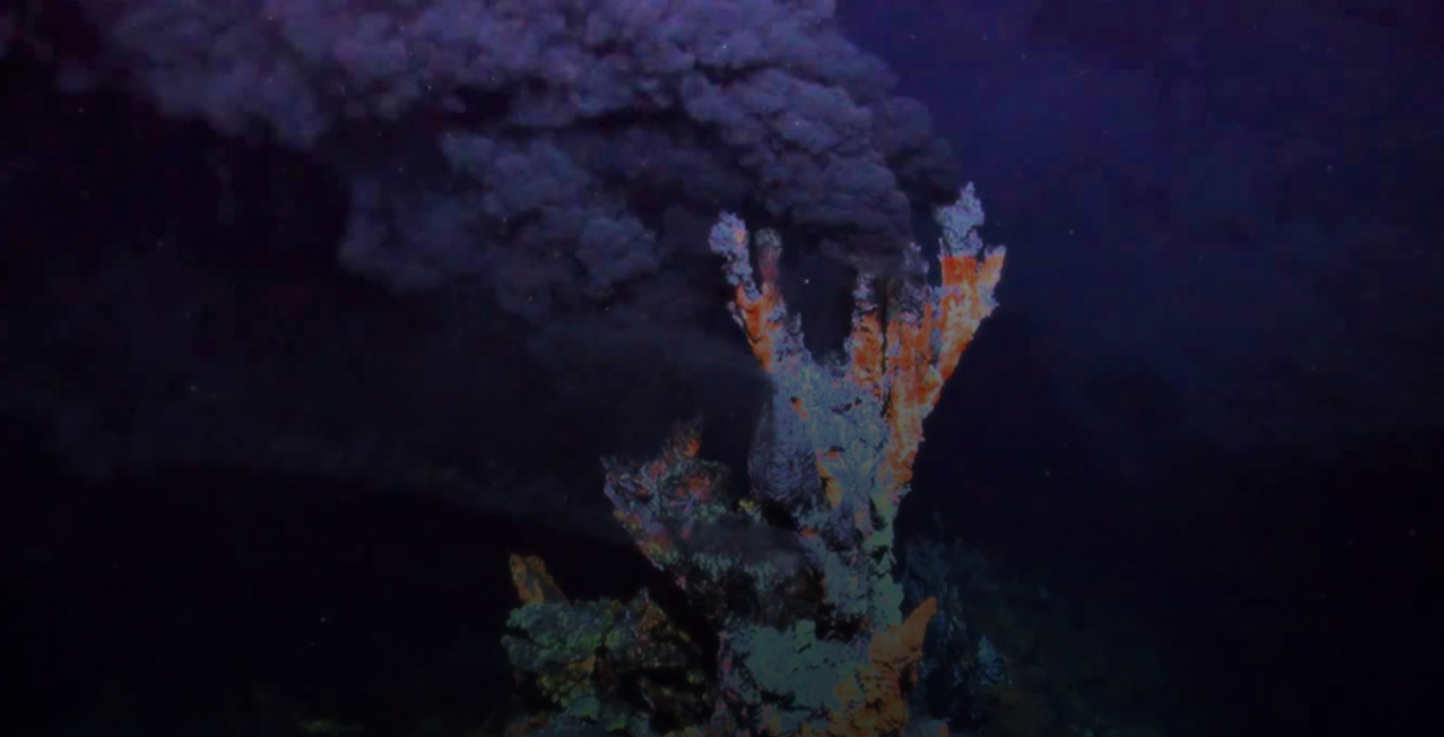
Hydrothermal vent on the ocean floor
Pausing to contemplate how life begins is a powerful way to fundamentally expand your experience. Read this narrative from Henry Gee’s A (Very) Short History of Life on Earth. He is describing one possible story of how life got stared in the thermal vents deep under water in the early years of the Earth. Amidst the chaotic motion around the vents, tiny pockets form where the turbulence is kept at bay. He stares into these pockets to find the emergence of regularity and repetition:
Protected from the chemical clamor of the outside world, these tiny pools were havens of order. Slowly, they refined the generation of energy, using it to bud off small bubbles, each encased in its own portion of the parent membrane. This was haphazard at first but gradually became more predictable as a result of the development of an internal chemical template that could be copied and passed down to new generations of membrane-bound bubbles. This ensured that new generations of bubbles were, more or less, faithful copies of their parents. The more efficient bubbles began to thrive at the expense of those less well-ordered. (A Very Short History of Life on Earth, 5)
Some images to contemplate as you place yourself in the scene:
Can you place a definitive boundary in this process where life begins?
Can you see anything inevitable about the origin of life in this narrative?
If you had to sort the organic from the inorganic, how would you make your determination?
What do you see as the chaotic and haphazard motions Gee describes ‘gradually became more predictable’? What does this tell you about not just the origins of life but how any kind of order emerges in the universe?
What do you see when you imagine the bubbles beginning to make copies of themselves?
Since life hasn’t fully happened yet, how can you even imagine yourself witnessing this scene?
Is any of this motion conscious of what it is doing? Are there even entities here that we could say are exercising something like intention, or purpose?
If not, how does consciousness arise after this? Is it born of an instant? Or must it too evolve out of these motions?
Put on your Darwinian hat: is this the beginning of natural selection? Or has natural selection happened before this process? Is anything like ‘selection’ happening here?
If you are an atheist: imagine the kind of God that would be operating here.
If you are a Christian: how do you square this with creation?
My Own Experience
This has been one of the most powerful contemplative exercises for me.
I not only find it impossible to place the boundary between living and non-living, but I learn that our retrospective imposition of this binary is a practical determination not rooted in what actually happened. Everything is in motion, and things start to happen when chaotic motion finds regularities. But what causes these regularities? Are there any natural laws at work here, or are the laws themselves being worked out as stable but ultimately temporary arrangements in the cosmos.
With respect to purpose, intent, and consciousness—I confront the radical contingency of our existence. Nothing here is determined. Gee writes this narrative downstream, in which consciousness, purpose, and intent are givens. We think they are natural and perhaps instantiated in our genus Homo all at once. But staring into this origin weakens that certainty. It opens questions of transparency—can we really see reality transparently?
See more Practices of Time