

Saving the Phenomenon: Panchrone, Assembly Theory and Thinking in Time
Books covered in this brief essay:
Michel Serres, The Incandescent, (2003, French; 2018 English translation by Randolf Burks, Bloomsbury)
Lee Smolin, Time Reborn: From the Crisis in Physics to the Future of the Universe (2014, Penquin)
Sara Imari Walker, Life As No One Knows It: The Physics of Life’s Emergence (2024, Riverhead Books)
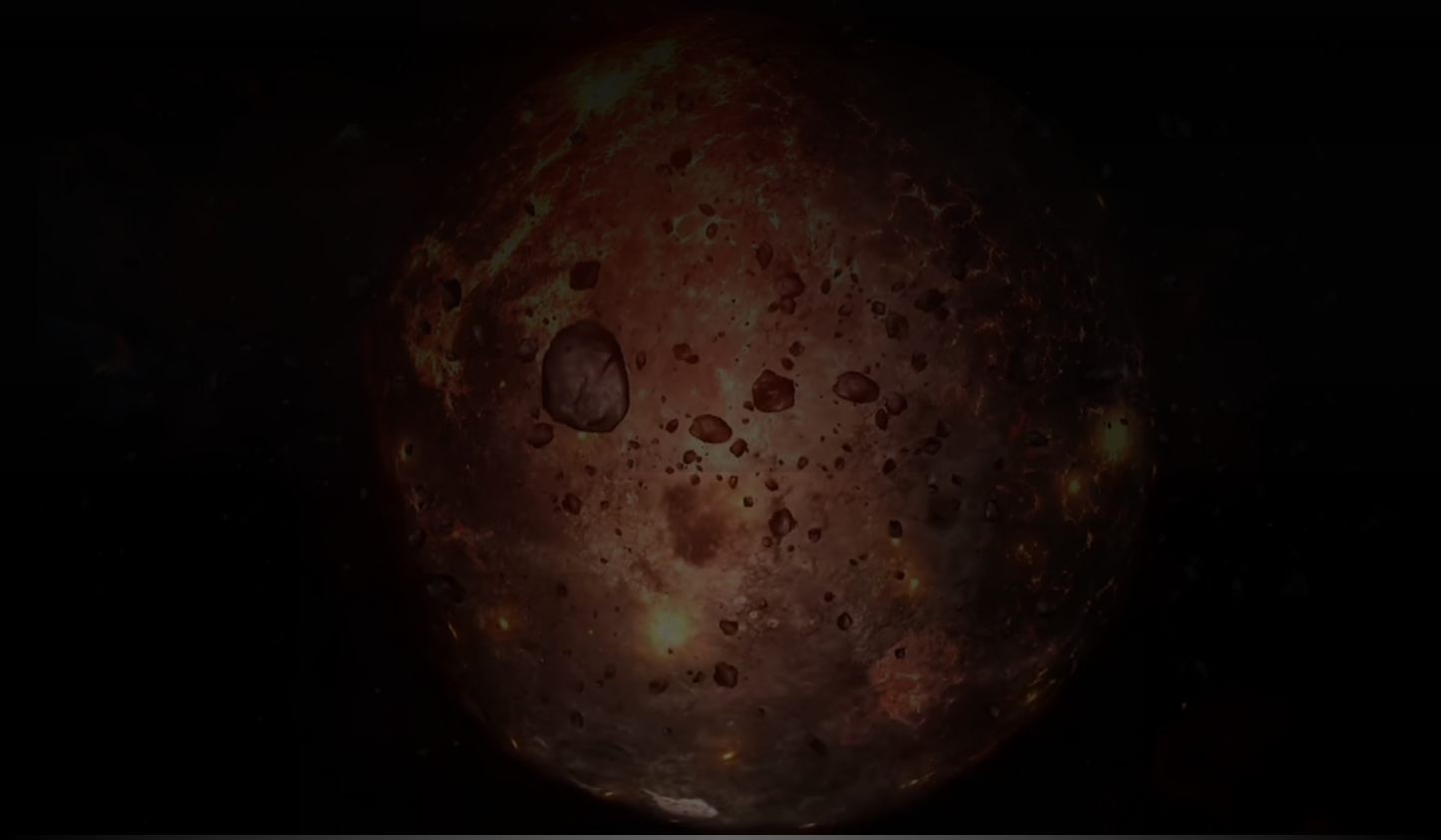
Envisioning the Earth before the possibility of life
Saving the Phenomenon
Time has always been a difficult object for human thought. As Toulmin and Goodfield showed in The Discovery of Time, much of our intellectual history has responded by pushing time into the background, treating it as a secondary variable within a world imagined primarily in spatial terms.
Perhaps this is no accident. To take time seriously is to confront a deeper problem: how order arises in a universe that offers no guarantees of being inherently orderly. The long project of saving the phenomenon has therefore tended to privilege spatial form over temporal process—just as Henri Bergson warned.
Michel Serres captures this difficulty with great clarity in the Pan sections of The Incandescent:
Traveling in pure space would leave the subject invariant; traveling in time does away with it. Panchrone has trouble being born, for he immediately vanishes; ten million years from here, he is already a quadruped; a little more and he crawls like a reptile or flies like a bird; lastly he is reduced to a single cell. (Randolf Burks trans. 121)
Our cultural imagination of time travel has largely followed the Doctor Who model. The traveler moves across eras but remains intact, unchanged in essence. This fantasy requires a conception of subjectivity as a sealed container—a universal object capable of passing untouched through history. It also smuggles in assumptions about consciousness: that it is a transparent eyeball, a neutral witness to reality rather than a product of it.
Serres’ figure of Panchrone dissolves this fantasy. To travel backward in time on Earth is not to visit earlier scenes on a stable stage; it is to dismantle the very conditions that make us possible. We are not merely in time—we are made of it. Our existence depends on immense chains of causation, layered across deep evolutionary and geological histories. Any serious attempt at time travel forces a reckoning with this fact. Our cherished image of subjectivity as a universal observer cannot survive the Cambrian Explosion or the Great Oxygenation Event.
Push far enough upstream and we do not arrive intact—we dissolve.
Serres makes the stakes explicit:
… through time I change, disappearing in going back up it but constructing myself in following it. I carry in my body the constituent elements of the Universe . . . there isn’t a single part of my flesh that isn’t left from a bifurcating event of this time . . . starting off from particles, I became a mirror of the Universe, not a spatial or optical representation mirror where rays walk in space like you or me, but a temporal one, by strata and traces that were contingent in the past, necessary today, constructive in any case. (122)
To engage time as Panchrone is to relinquish a familiar picture of subjectivity. Consciousness is not a window onto a fixed reality; it is an accumulation of traces, a contingent achievement. Transported far enough into the past, we would enter an Earth not yet capable of producing beings like us.
Time is not something we pass through; it is what assembles us—and what can unmake us.
Yet something important follows from this loss. If we abandon spatial universality, we do not abandon universality altogether. We recover it in a different register. We are of the same order as everything else that unfolds in time. Our commonality with the universe is not geometric but temporal.
Assembly Theory
Some theoretical physics are channeling this intuition. Sara Imari Walker’s assembly theory places time at the center of ontology itself. ‘Every object,’ she writes, ‘exists in “time” as the aggregation of recursive paths by which the universe can assemble it’ (Life as No One Knows It, 134). Complexity, on this view, is not merely spatial arrangement but temporal depth. Complex matter has extension not just in space, but in time.
Nothing is ever different in kind, only in degree.
Before humans can exist, an enormous amount must happen just to get to the possibility of us. To describe that process solely in terms of spatial relations among particles is to miss the more consequential dimension: how long it takes for certain forms to become possible at all. As Walker succinctly puts it, the universe is far bigger in time than it is in space.
Assembly theory has a Panchronic consequence for how we think about ‘extension’: ‘what assembly theory is telling us is that complex matter is complex because it has a physical extent not just in space, but in time too (134).
Thinking in Time
In Time Reborn, Lee Smolin reopens the question of time’s fundamentality. For Smolin, taking time seriously requires confronting the Newtonian legacy that has shaped physics for three centuries. Even Einstein, he argues, remained Newtonian on this point:
Relativity strongly suggests that the whole history of the world is a timeless unity; present, past, and future have no meaning apart from human subjectivity. Time is just another dimension of space, and the sense we have of experiencing moments passing is an illusion behind which is a timeless reality. (Time Reborn, xxii)
This reduction of time to space—the Block Universe—is precisely what Bergson resisted. Smolin follows him in pressing the critique further. When we imagine the universe as governed by immutable laws operating outside time, we foreclose better explanations of causation, novelty, and order itself.
This bias is not confined to physics. It shapes how we think more generally. We imagine answers existing in an eternal realm of truth, waiting to be discovered—whether the question concerns parenting, citizenship, or the optimal organization of society, even mathematics. Even those who insist that truth is constructed often smuggle in timelessness through the back door. ‘Truth is always a construct’ easily becomes a universal claim immune to history, context, or revision.
Smolin’s target is not truth-seeking but the way we frame it before the search even begins. Categories like parent, citizen, secular, sacred, nature, culture are routinely treated as timeless givens rather than historical achievements. We assume they were born fully formed, needing no temporal reconstruction.
Underlying this habit is a particular image of order: eternal laws guaranteed by something Godlike. If the universe has an origin, these laws must either arrive fully formed at the beginning or hover outside time, waiting to descend. Either way, they are imagined as immune to history.
Smolin rejects this convenience. Laws, he argues, are not imposed from outside the universe, nor do they wait beyond time for their moment to act. They ‘emerge from inside the universe and evolve in time with the universe they describe.’ Just as in biology, genuinely new regularities may arise as the universe develops (Time Reborn, xxvii).
This is why Smolin turns to Darwin. Evolution offers a model of order without timeless guarantees—a way of understanding stability, novelty, and constraint as products of history rather than its preconditions. To think this way requires time to be reborn as a genuine constituent of reality.
To assert that ‘the laws of nature emerge from inside the universe and evolve in time with the universe’ is to find ourselves, like Serres did, having to completely rethink the relationally of causation, motion, and change. All of which means putting time back on the metaphysical table as a problem to be theorized. To do so requires ‘jettisoning the excess metaphysical baggage that weighs down our search for truth’ (Time Reborn, xxvii).
What emerges is a universe whose order is not given in advance but made—slowly, contingently, and irreversibly—through time itself.